

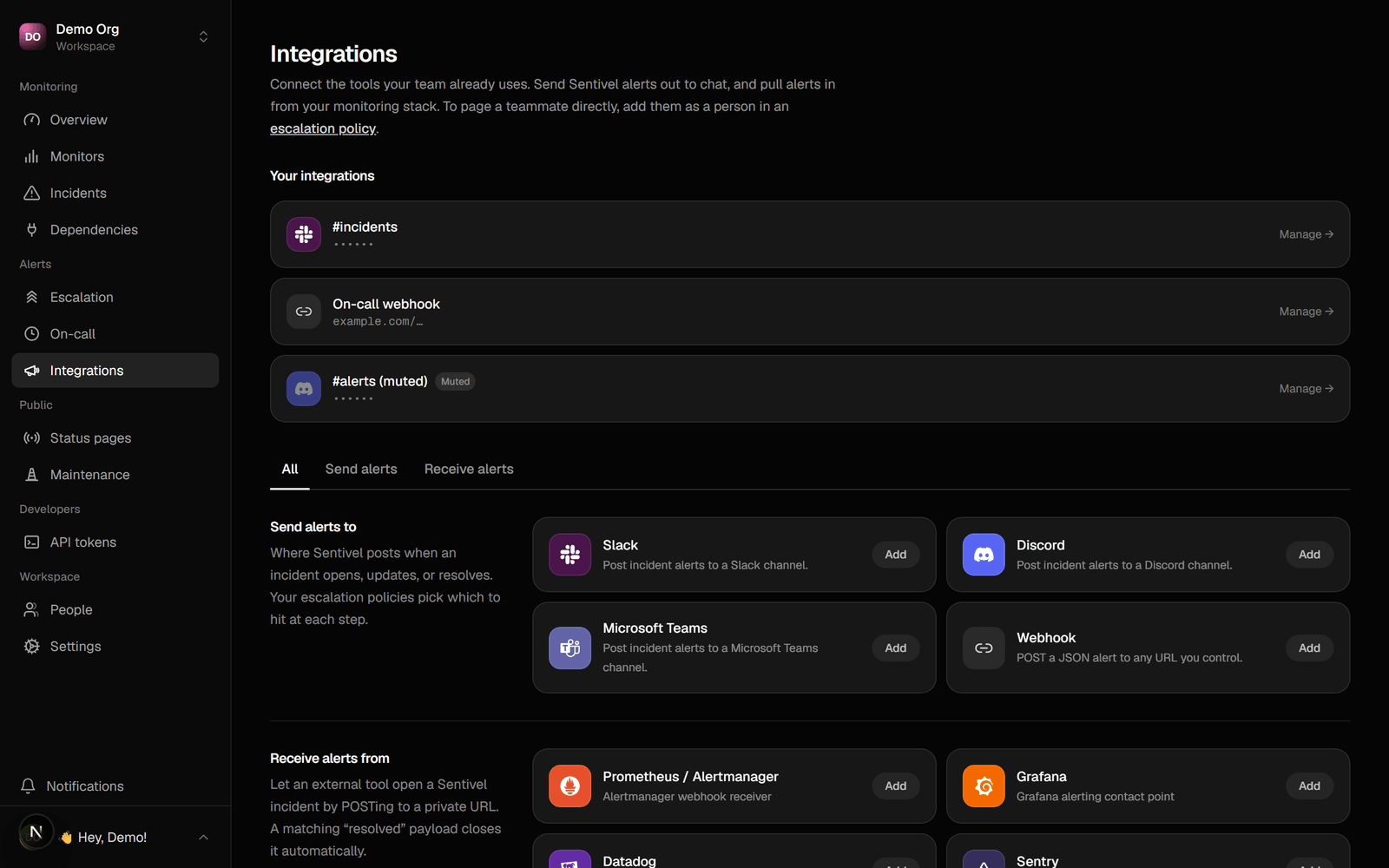
Outbound destinations
- Slack. Post incidents to a channel.
- Discord. Post incidents to a channel.
- Microsoft Teams. Post to a Teams workflow (incoming webhook).
- Webhook. POST a JSON payload to any URL you control.
Webhook payloads
A Webhook destination receives aPOST with Content-Type: application/json.
The same reference appears in the dashboard when you add or edit one. Slack, Discord,
and Teams destinations receive a provider-shaped body instead, so build against the
Webhook type.
Sentivel sends three events. Branch on the event field.
incident.opened
incident.resolved
incident.escalated fires on each escalation step while the incident is
unacknowledged. It carries the open fields plus step and cycle.
incident.escalated
ackUrl is present only while an incident is open and the Acknowledge button is
enabled for that destination. There is no signature header yet, so keep the secret
in the URL path and treat the endpoint as unlisted.
To drive a banner on your own site, switch it on for incident.opened and clear it
on incident.resolved, keyed off component.
Inbound sources
Turn an external alert into a Sentivel incident:- Incoming webhook. A per-integration signed URL. POST to it and Sentivel opens an incident, mapping the payload to a title and metadata.
- Email to incident. A unique address per integration; the subject and body become the incident.
What to send us
Create an inbound source and you get a private receive URL.POST JSON to it. No
Bearer token: the unguessable URL is the credential, and you can add a signing
secret for HMAC on top.
Open an incident
The smallest useful call is a
title and a severity. Every field is optional.
Resolve an incident by sending the same fingerprint again with a resolved
status.
Resolve it
X-Signature: sha256=<HMAC-SHA256>. A successful call returns
{ "ok": true, "action": "opened", "incidentId": "..." }.